
Commercial Earth observation (EO) has undergone a quiet transformation over the past decade. Long established as a mission-critical input to modern defense and intelligence operations, the commercial EO industry has steadily expanded from a niche, pixel-driven marketplace into a foundational Intelligence, Surveillance and Reconnaissance (ISR) capability. Today, dozens of providers offer global coverage, high-resolution imagery and increasingly frequent revisit rates.
But access alone is no longer the problem.
As commercial EO has scaled, a more fundamental challenge has emerged: reliability of delivery. Expanded availability has not translated into predictable outcomes, and for time-sensitive intelligence missions, that gap is becoming increasingly costly.

Expanded island-building work | Ladd Reef, South China Sea | 11 Nov. 2025
How “best effort” became the default
The current commercial EO market is often described as first-come, first-served, or what we call “best-effort,” in which providers make an attempt to collect and deliver intelligence in a timely manner, but there is no guarantee.
The prevalence of best-effort tasking models is not accidental. In the early days of commercial EO, these models fit the mission. Government systems handled core requirements, while commercial imagery offered flexible, supplemental coverage. For non-time-critical use cases, best effort provided agility without contractual complexity.
The problem is that the mission changed—while the model did not.
Today, commercial EO is embedded directly into ISR supply chains. Tasking, licensing and delivery are institutionalized. Commercial constellations support geographically dispersed, time-sensitive operations. Yet the underlying commitment remains probabilistic: providers commit to effort, not delivery, and customers absorb the operational risk when collections fail.
Why access doesn’t equal certainty
For today’s ISR planners, the central question is no longer whether imagery exists—or even whether it can be tasked. The real question is whether the right intelligence will reach the right decision-maker at the right time, with the certainty mission success demands.
That uncertainty has created a fragile operational environment. And its effects compound quickly.
In high-demand regions, over-tasking and under-delivery have become routine. As more customers compete for limited satellite collection windows, tasking success rates—especially for time-sensitive requests—decline. Collections are re-tasked, delayed or never fulfilled at all.
When that happens, the mission clock does not stop. Analysts adapt by relying on older imagery, waiting for alternate collections or reshaping workflows mid-stream. Over time, these gaps disrupt intelligence continuity and erode confidence in the ISR supply chain.
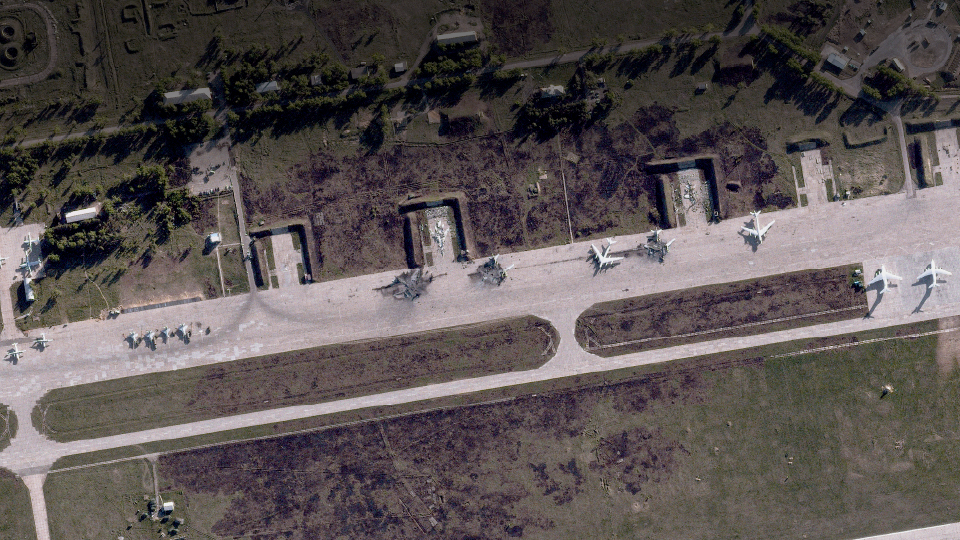
Airstrike damage | Belaya Air Base | Irkutsk, Russia | 5 June 2025
The hidden cost of uncertainty
Unreliable delivery also slows operational tempo. Without confidence in tasking fulfillment, planners compensate by building redundancy into every step of the process—tasking multiple satellite providers for the same target, reprocessing analytics on outdated data or padding timelines to absorb delays.
This effort rarely appears in formal metrics, but its impact is real. It acts as an invisible tax on readiness, situational awareness and decision speed—precisely the advantages ISR is meant to provide.
While subscription-based EO platforms have significantly expanded accessibility for more tasking collections and vast imagery libraries, the reality is that access alone does not guarantee outcomes. In time-critical situations, intelligence loses value rapidly if it cannot be delivered predictably and on schedule.
A growing misalignment
Modern ISR missions increasingly depend on persistent monitoring, cross-theater responsiveness and AI-enabled workflows that require predictable data streams. In that environment, best-effort tasking no longer scales.
What was once an advantage—open access—becomes a liability when mission success depends on guaranteed outcomes.
The commercial EO market is now at an inflection point. Meeting today’s operational demands will require moving beyond access-based models toward frameworks built on certainty, accountability and assured delivery.
To explore this challenge further—and what comes next—download our white paper, From Access to Assurance: Introducing Certainty into Commercial Earth Observation Subscriptions.